
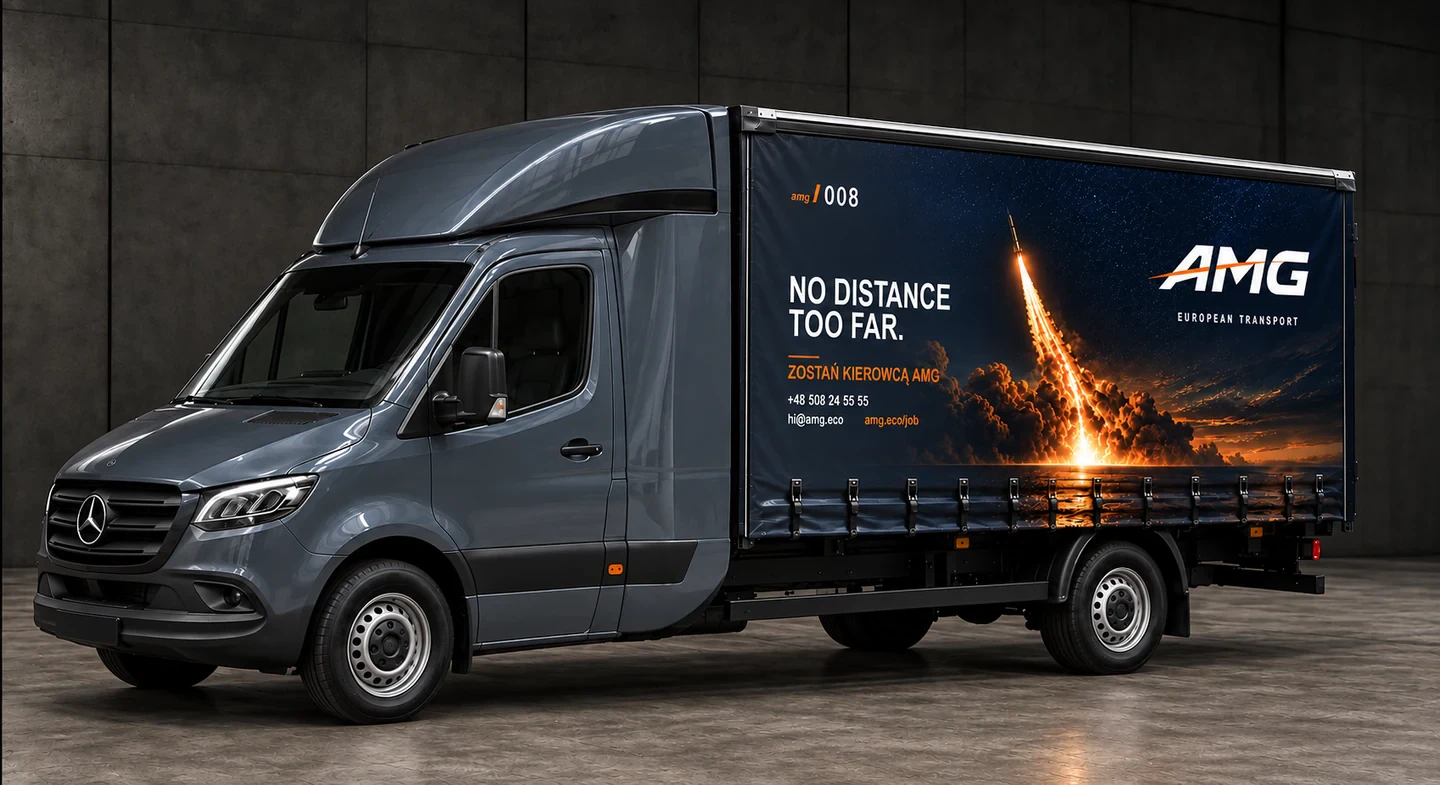
Editorial update: 2 October 2026. The original article date is retained; the regulatory and service information below has been updated for this translation.
International transport using small delivery vans with a maximum authorised mass of up to 3.5 tonnes is a rapidly developing part of logistics. It plays an important role for manufacturers, trading companies and logistics businesses in Europe. In this 2025 guide, we explain what transport up to 3.5 tonnes involves, its benefits and the EU rules that apply, including the Mobility Package. We also discuss the carriage of special goods, such as dangerous goods under ADR, and practical guidance for customers ordering transport.
What is international transport up to 3.5 tonnes, and who is it for?
A 3.5-tonne limit describes the vehicle’s maximum authorised total mass, not its cargo capacity. Payload varies with the body, equipment and actual vehicle mass; a generic figure such as 1–1.5 tonnes is not a promise for every van. AMG’s current vehicle offer states 700 kg and up to 8 Euro pallets, subject to the load dimensions and vehicle selection. Confirm both mass and usable space before accepting the order.
Transport up to 3.5 tonnes is often used by manufacturers supplying components to foreign factories, trading companies sending goods to customers in the EU and logistics operators arranging door-to-door deliveries of urgent shipments. AMG-Trans has extensive experience with these orders. Discover our van transport service up to 3.5 tonnes.
Uses and advantages of transport up to 3.5 tonnes compared with truck transport
Van transport up to 3.5 tonnes is widely used in B2B logistics, filling the gap between courier shipments and full truckloads. These are the main advantages that distinguish it from truck transport:
- Speed and express delivery: smaller vehicles can travel faster and are not subject to some restrictions that apply to trucks. As a result, van deliveries arrive sooner. Transport up to 3.5 tonnes is suitable for urgent shipments requiring express delivery. Learn more about our express transport service.
- Flexibility and door-to-door delivery: vans up to 3.5 tonnes can reach practically any location. They can enter narrow streets inaccessible to large trucks and carry loads directly from door to door without transshipment. This is a major advantage for fragile goods and just-in-time shipments.
Costs depend on the route, load, vehicle, tolls and required delivery window. Historical savings based on the absence of tachographs should not be assumed after 1 July 2026 for vehicles within the new rules. Compare an actual quote and a lawful route plan; a lighter vehicle does not remove driving-time, access or local traffic restrictions that apply to its operation.
EU rules and the Mobility Package in 2025: what should you know?
Since 21 May 2022, a Community licence is required for international carriage of goods for hire or reward with vehicles or vehicle combinations whose maximum authorised mass exceeds 2.5 tonnes. The threshold includes any trailer. The applicable exemptions must be checked; this is not a requirement for every vehicle below 3.5 tonnes. Operators within scope must also meet the professional, financial and good-repute requirements.
Since 1 July 2026, EU driving-time, break and rest rules and the smart tachograph version 2 requirement apply to goods vehicles or combinations exceeding 2.5 tonnes used in international transport or cabotage. Vehicles above 3.5 tonnes were already within scope. Exceptions remain, including certain own-account operations with combinations above 2.5 and up to 3.5 tonnes where driving is not the driver’s main activity. Check the vehicle, operation and exemption together.
For posted drivers within Directive 2020/1057, submit the declaration through the EU road-transport portal connected to IMI, at the latest when the posting starts, and keep it up to date. A declaration covers a driver, a host country and the declared period; it is not a separate notification of every individual load. Cabotage and cross-trade generally involve posting; bilateral transport and transit have exemptions. National portals such as SIPSI or MiLoG are not the notification channel for EU operators within this directive.
Driver-return duties and vehicle-return duties are different. Where Regulation 561/2006 applies, the undertaking must organise the driver’s opportunity to return home or to the operational centre within the applicable three- or four-week cycle. The former requirement to return the vehicle every eight weeks was annulled by the Court of Justice on 4 October 2024. It must not be presented as a current obligation.
ADR transport up to 3.5 tonnes: can vans carry dangerous goods?
Vans can carry dangerous goods, but the requirements depend on the UN number, class, packaging, quantities and the applicable ADR exemptions. A driver’s ADR certificate, orange plates and the full equipment requirements are not mandatory for every small shipment: limited quantities and the exemption in ADR 1.1.3.6 have different conditions. Training and other duties may still apply. Provide the classification and quantities before requesting transport, so the actual documentation, training and equipment can be determined.
The most common routes and destinations served
AMG organises transport on European routes according to the enquiry, loading and delivery windows and available capacity. Regular cooperation can be agreed for a recurring need. The routes shown on the website illustrate transport directions; they are not a published timetable or a promise of fixed shuttle departures. Confirm availability and timing for the specific shipment.
See our shuttle routes between EU countries (PL)
Examples of use: which industries use transport up to 3.5 tonnes?
- The automotive industry: just-in-time delivery of car parts and components to production lines. Car manufacturers often use fast van deliveries to avoid downtime. A missing component can be brought from a foreign factory in as little as a dozen or so hours.
- Trade and distribution: wholesalers and distributors use vans to supply shops or warehouses in other countries urgently. This allows them to respond quickly to unexpected demand or shortages on shop shelves.
Practical guidance for customers ordering transport
- Accurate load information: give the carrier the dimensions, weight and type of goods, including whether they are fragile or dangerous. This allows the transport company to choose the appropriate vehicle and protective measures.
- Suitable packaging: make sure the goods are securely packed and protected for a long journey. Wrap pallets in stretch film and secure them with straps; protect boxes with packing material. Robust packaging minimises the risk of damage.
- Formalities and documents: the standard document is the CMR consignment note. Make sure all the information is correct. If additional documents are needed, for example ADR documents, prepare them in advance to avoid delays.
- Ongoing contact: give the carrier current telephone numbers for the people responsible for loading and unloading. The driver usually calls before arrival. Be available by telephone to provide any necessary instructions.
Summary
International transport up to 3.5 tonnes is an important part of the supply chain. It combines speed and flexibility with increasingly regulated service conditions, supporting safety and reliability. Working with an experienced carrier such as AMG-Trans allows you to make full use of these advantages. See for yourself: order transport and discover how easily your shipment can begin its journey.
Categories
Contact us.
Find out how we can help. Complete the short form.
FAQ
Frequently asked questions
What exactly does “transport up to 3.5 tonnes” mean?
It means carrying goods in delivery vehicles with a maximum authorised mass of up to 3.5 tonnes, including vans and small trucks. It is used for fast international deliveries when a full-sized truck would not be filled or arranging that transport would take too long.
Is transport with vans up to 3.5 tonnes subject to the same rules as truck transport?
Since 21 May 2022, a Community licence is required for international carriage of goods for hire or reward with vehicles or vehicle combinations whose maximum authorised mass exceeds 2.5 tonnes. The threshold includes any trailer. The applicable exemptions must be checked; this is not a requirement for every vehicle below 3.5 tonnes. Operators within scope must also meet the professional, financial and good-repute requirements.
Since 1 July 2026, EU driving-time, break and rest rules and the smart tachograph version 2 requirement apply to goods vehicles or combinations exceeding 2.5 tonnes used in international transport or cabotage. Vehicles above 3.5 tonnes were already within scope. Exceptions remain, including certain own-account operations with combinations above 2.5 and up to 3.5 tonnes where driving is not the driver’s main activity. Check the vehicle, operation and exemption together.
Can I order transport up to 3.5 tonnes online?
Yes. The AMG website lets you prepare a transport enquiry step by step, with the route, load and dates. Submitting an enquiry does not automatically confirm a booking: price, availability and the final transport terms must be agreed with the team. The form helps provide complete information; no fixed completion time is promised.
Sources checked for this update: EU · 2020/1055 · EU · 561/2006 · EU · IMI · CJEU · C-541/20–C-555/20 · UNECE · ADR 2025